Wednesday, October 12, 2016

PHONETICS II
PROBLEMATIC SOUNDS FOR SPANISH SPEAKERS

Article taken from http://www.tefl.net/elt/articles/teacher-technique/spanish-speaker-pronunciation-problems/

Pronunciation Problems For Spanish-Speaking Learners Of English

Pronunciation problems and solutions for all speakers of Spanish.
Although a strong Spanish accent is usually easier to understand than a similarly strong French or Portuguese one, the pronunciation can cause considerable strain for the listener and seem somewhat harsh and flat. More importantly, Spanish speakers often have listening comprehension far below their other skills.
School English lessons in most Spanish-speaking countries also tend to focus much more on reading and grammar than speaking and listening, and so pronunciation work will both help redress the balance and be considered worthwhile by students.
This article will focus mainly on pronunciation problems that cause miscomprehension, including some attempt to prioritise the entries in each section. The sections themselves are arranged more traditionally, starting with individual sounds.

Points That Spanish-Speaking Learners Of English Find Difficult

Vowels

Short and long vowel pairs

Perhaps the single biggest pronunciation problem for Spanish speakers is that their language does not have a distinction between short and long vowels. They often stretch all vowel sounds out too much and confuse pairs of short and long English vowel sounds like “ship” and “sheep” both in comprehension and speaking. Relevant pairs include:
  • bit/beat
  • not/note and not/nought
  • batter/barter
  • pull/pool
As the pairs above are all pronounced with different mouth positions as well as different lengths, focusing on that can help students distinguish between the minimal pairs above even if they don’t fully get the hang of vowel length.

Other vowels

In common with most learners, Spanish speakers find the distinction between the very similar sounds in “cat” and “cut” difficult to notice and produce. Perhaps more importantly, they can also have problems with the two closest sounds to an “o” sound in “not” mentioned above, making “boat” and “bought” difficult to distinguish. The unstressed schwa “er” sound in “computer” does not exist in Spanish, and neither do the closest long sounds in “fur” and “her”. Spanish speakers tend to find it much more difficult to recognise not rhotic versions of vowel sounds.

Consonants

Words written with “b” and “v” are mostly pronounced identically, making this perhaps the most common spelling mistake in Spanish. There is also no distinction between the first sounds in “yacht” and “jot” in Spanish and which of those two sounds is perceived by English speakers tends to depend on the variety of Spanish spoken (this being one of the easiest ways of spotting an Argentinean accent, for example). There may also be some confusion between the first sound in “jeep” and its unvoiced equivalent in “cheap” (a common sound in Spanish).
The “ch” in “cheese” may also be confused with the “sh” in “she’s”, as the latter sound does not exist in Spanish. The difference is similar to that between “yacht” and “jot” mentioned above, being between a smooth sound (sh) and a more explosive one (ch), so the distinction can usefully be taught as a more general point. Alternatively, the “sh” in “sheep” may come out sounding more like “s” in “seep”, in which case it is mouth shape that needs to be worked on.
Spanish words never start with an “s” sound, and words which are similar to English tend to have an initial “es” sound instead, as in escuela/school. This is very common in Spanish speakers’ pronunciation of English as well, leading to pronunciations like “I am from Espain”. Spanish speakers have no problem producing a hissing sound, so the secret is to have them make the word directly after that “ssss” and then practise reducing the length of that down to a short initial “s”.
Unlike most languages, the “th” sounds in “thing” and “bathe” do exist in Spanish. The problem with “bathe” is that the sound is just a variation on mid or final “d” for Spanish speakers and so some work on understanding the distinction between initial “d” and initial “th” is usually needed before it can be understood and produced in an initial position – in fact making the amount of work needed not much less than for speakers of languages entirely without this sound. The problem with “thing” and “sing” is different as it is a distinction that exists in some varieties of Spanish and not others, meaning that again for some speakers practice will need to start basically from zero.
Some speakers also pronounce a final “d” similar to an unvoiced “th”. “d” and “t” can also be a problem at the end of words, as can “thing”/“think” and sometimes “thing”/“thin” or even “ring” and “rim”. In general, Spanish consonant sounds vary more by position than English consonants do.
Although a “w” sound exists in Spanish, it is spelt “gu” and can be pronounced “gw”, sometimes making it difficult to work out if a “g” or “w” is what is meant.
As a “z” is pronounced as “s” or “th” (depending on the speaker, as in the two pronunciations of “Barcelona”), a “z” sound does not exist in Spanish. However, perhaps because not so much air is produced in a Spanish “s” I find that this version rarely produces comprehension problems.
Although a Spanish “r” is different from most English ones, it rarely causes comprehension problems. However, the English “r” can seem so soft to Spanish speakers that it is sometimes perceived as “w”.
The Spanish “j” in José (similar to the Scottish “ch” in “loch”) and the English “h” in “hope” rarely if ever cause communication problems, but is perhaps the main thing to work on if students are interested in accent reduction. An English “h” is like breathing air onto your glasses so you can polish them, and students can actually practise doing that to help.
Spanish doesn’t have the soft, French-sounding sound from the middle of “television” and “pleasure”, but this rarely if ever causes comprehension problems.

SYNTAX 
TEXT FOR DISCOURSE ANALYSIS 

READ THE TEXT YOU WILL GET BY CLICKING  ON THIS LINK. REMEMBER TO TAKE IT TO NEXT CLASS. 

Tuesday, September 20, 2016

SYNTAX II
2nd Activity

Verb Types and Objects


Read the following sentences and determine the type of verb in each one. Also, state the direct and indirect objects they may have. 


Again each one of you must analyze a different sentence


1. Karen gave a dog biscuit to the puppy.
2. The ATM machine spewed money at the surprised young woman.
3. The librarian carried the books and magazines to the researcher.
4. Walking to school on a fall day, the children selected fallen leaves for show-and-tell. 
5. Sparta defeated Athens in the Peloponnesian War.
6. The company hired a personable manager for its customer service position.
7. The child needs a speech therapist to help her improve her enunciation.
8. The people of China gave pandas to the people of the United States.
9. Gary decorated the cake as a surprise for his family.
10. Although she did not consider it a good influence, Jeanetta bought a new television for the family room. 
11. George is the captain.
12. The judge pronounced the judgment.
13. My sister looked worried.
14. Parents should be kind to their children.
15. Mother brought us tea.
16. The officer asked him several questions.
17. Let us send him our greetings.
18. We should keep our surroundings clean.
19. My aunt has brought me a computer.
20. The class elected Martin their monitor.
21. Our visit made the host happy.
22. This book is interesting.

LINGUISTICS III 
2nd Activity

PARTS OF SPEECH - TYPE OF PHRASES


Read the following sentences and state the type of word or phrase you see underlined or in bold. Each one of you has to choose one sentence and post your analysis according to the criterion worked in class. 


1. Vampires Dairies is my favorite television show, but I also love True Blood.

2. The student wiped the white board that was filthy with last week’s notes.

3. The trendy fashion designer released her new line on Wednesday.

4. Trina and Hareem went to a bar in Hollywood to celebrate their anniversary.

5. Wicked Regina cast a spell on the entire city, so the citizens decided to rebel.

6. While waiting for the paint to dry, Angela went to Home Depot, and Martin organized the
kitchen appliances.

7. After listening to the Kanye West CD, I have new respect for his music.

8. After the teacher chose groups, John and Sara were selected as partners for a project, yet
Sarah did most of the work.

9. I love skiing, my brother loves snowboarding, and my sister likes snow tubing.

10. If you do not want to join marching band, you should find another extracurricular activity. 

PHONETICS II
1st Activity 

Consonant sounds in English

Remember to take your answers to class on a piece of paper. 


1. Look at the following transcription and write down the words they represent.

mi:t

fɑind

rɐf

saund

bæʃ

ʃip

la:f

tʃɪps

ðem

tæks

æɪks

2. Transcribe the following sentences:


  • Linguistics is a that requires your attention. 
  • People have to work hard on what they ewant to accomplish. 
  • Some of the most complicated things are not that difficult after a while. 

LINGUISTICS II 
2nd activity
SENTENCE TYPES


 Identify whether the sentences are simple, complex, compound or compound-complex; also, underline dependent clauses where it applies. 

Each one of you must do 3 different sentences. 

Remember to post your answers in the comment section. 


1. Vampires Dairies is my favorite television show, but I also love True Blood.
2. The student wiped the white board that was filthy with last week’s notes.
3. The trendy fashion designer released her new line on Wednesday.
4. Trina and Hareem went to a bar in Hollywood to celebrate their anniversary.
5. Wicked Regina cast a spell on the entire city, so the citizens decided to rebel.
6. While waiting for the paint to dry, Angela went to Home Depot, and Martin organized the
kitchen appliances.
7. After listening to the Kanye West CD, I have new respect for his music.
8. After the teacher chose groups, John and Sara were selected as partners for a project, yet
Sarah did most of the work. 
9. I love skiing, my brother loves snowboarding, and my sister likes snow tubing.
10. If you do not want to join marching band, you should find another extracurricular activity. 
11. Whenever I hear classical music, I immediately get sleepy.
12. In the middle of the night, my little sister screamed at the top of her lungs because she had a nightmare, and I ran to comfort her.
13. I washed and vacuumed the car. 
14. We ordered pork tenderloin for our entrée and scalloped potatoes for our side dish.
15. We have nothing to fear but fear itself. 
16. I now understand simple, compound, and compound-complex sentences.

Wednesday, September 14, 2016


Sentence type activity 


Read the following paragraphs. Choose 5 sentences from any of them, state their type and identify its elements (S-V-C, conjuunctions, clauses). You have to do this in the comment section below. 


It is important for you to work on different sentneces. I mean that you are not supposed to choose sentences already analyzed by other classmates. 


1- A topic sentence is the most important sentence in a paragraph. 2- Sometimes referred to as a focus sentence, the topic sentence helps organize the paragraph by summarizing the information in the paragraph.3-  In formal writing, the topic sentence is usually the first sentence in a paragraph. 
4- A topic sentence essentially tells what the rest of the paragraph is about. 5- All sentences after it have to give more information about the sentence, prove it by offering facts about it, or describe it. 6- For example, if the topic sentence concerns the types of endangered species that live in the ocean, then every sentence after that needs to expound on that subject. 

7- Topic sentences also need to relate back to the thesis of the essay. 8- The thesis statement is like a road map that will tell the reader or listener where you are going with this information or how you are treating it. 

8- Reading literature is a pleasurable, entertaining activity that offers readers the potential to escape from the troubles of daily life. 9- Above all else, literature survives because of its capacity to entertain readers.10-  Literature also has the power to provoke thought in readers, making it a leisure activity that is also intellectually productive.11-  Literature also has the power to impart a wide variety of experiences to readers. 12- A story can expose readers to different places, time periods, viewpoints and cultures. 13- Readers can gain experiences through literature they would never have access to in ordinary life. 14- Literature's ability to capture the imagination and depict the lives of others also increases readers' ability to empathize with others.15-  A study published in the journal Science found that readers of literary fiction demonstrated an increased ability to infer other people's thoughts and emotions. 16- Finally, literature helps develop critical-thinking skills.17-  Readings and discussions of literature force readers to make reasoned judgments about character motivations, cause and effect, critical analysis of plot and more.

17- When applying for a job, good skills to list on a resume or application include the ability to solve complex problems, employ critical thinking, listen actively, use good judgement and make reasoned, rational decisions accordingly. 18- Having knowledge of complex and technically-oriented disciplines is also a plus, such as an above-average understanding of computers, certain machinery and electronics. 19- Knowing how to solve mathematical equations ranks high on the list of favorable qualities in potential employees, as does operations and systems analysis, monitoring, programming and marketing.

20- Critical thinking tops the list of most desirable qualities in job applicants, according to Forbes. 21- It requires the use of analysis and comparison to evaluate pros and cons or strengths and weaknesses of tools, products and companies, as well as the capacity to identify alternative solutions and conclusions and make smart decisions. 22- Employers seek candidates with the ability to identify and correct difficult problems. 23- This entails finding problems, then evaluating alternatives to solve them. 24- Possessing good judgment and making sound decisions is another good skill to list on an application. 25- This conveys the ability to consider and evaluate costs and options before choosing the best solution. 26- Active listening skills exhibit the ability of candidates to understand fellow workers and managers, and perform well in team environments.

27- Literature is the foundation of life. It places an emphasis on many topics from human tragedies to tales of the ever-popular search for love. 28- While it is physically written in words, these words come alive in the imagination of the mind, and its ability to comprehend the complexity or simplicity of the text. 29- Literature enables people to see through the lenses of others, and sometimes even inanimate objects; therefore, it becomes a looking glass into the world as others view it. 30- It is a journey that is inscribed in pages, and powered by the imagination of the reader. 31- Ultimately, literature has provided a gateway to teach the reader about life experiences from even the saddest stories to the most joyful ones that will touch their hearts.

32- From a very young age, many are exposed to literature in the most stripped down form: picture books and simple texts that are mainly for the sole purpose of teaching the alphabet etc. 33- Although these are not nearly as complex as an 800-page sci-fi novel, it is the first step that many take towards the literary world. 34- Progressively, as people grow older, they explore other genres of books, ones that propel them towards curiosity of the subject, and the overall book. 35- Reading and being given the keys to the literature world prepares individuals from an early age to discover the true importance of literature: being able to comprehend and understand situations from many perspectives.

36- Physically speaking, it is impossible to be someone else. 37- It is impossible to switch bodies with another human being, and it is impossible to completely understand the complexity of their world. 38- Literature, as an alternative, is the closest thing the world has to being able to understand another person whole-heartedly. 39- For stance, a novel about a treacherous war, written in the perspective of a soldier, allows the reader to envision their memories, their pain, and their emotions without actually being that person. 40- Consequently, literature can act as a time machine, enabling individuals to go into a specific time period of the story, into the mind and soul of the protagonist.

41- With the ability to see the world with a pair of fresh eyes, it triggers the reader to reflect upon their own lives. 42- Reading a material that is relatable to the reader may teach them morals and encourage them to practice good judgement. 43- This can be proven through public school systems, where the books that are emphasized the most tend to have a moral-teaching purpose behind the story. 44- An example would be William Shakespeare’s stories, where each one is meant to be reflective of human nature . 45- Consequently, this can promote better judgement of situations, so the reader does not find themselves in the same circumstances as perhaps those in the fiction world. 46- Henceforth, literature is proven to not only be reflective of life, but it can also be used as a guide for the reader to follow and practice good judgement from.


Monday, September 12, 2016


Characteristics of Language


These links will take you to pages in which you'll find info about the charateristics or properties of language stated by Yule. 


After you have read on this topic provide one example for each of the characteristics of how it is possible to notice those characteristics in our everyday communication. 

Wednesday, September 7, 2016


The Different Classification of Sentences
Adated from https://freelance-writing-articles.knoji.com/the-different-classification-of-sentences/


There are different classifications of sentences. They are classified according to purpose, according to syntax or structure, according to form and according to completeness.


Sentences are classified according to purpose. They are further classified into declarative sentence, interrogative sentence, imperative sentence and exclamatory sentence.

Sentences are classified according to syntax or structure. These classifications are in the form of simple sentence, compound sentence, complex sentence and compound-complex sentence.
The sentence is considered as a simple sentence if it contains only a single independent thought or clause. In this kind of sentence, the subject, the verb and the complement maybe compounded or either modified by a single word or phrase.
The sentence is considered a compound sentence when it consists of two or more Co-ordinate clauses; Sometimes the subject is omitted in the second coordinate clause.
The sentence is considered as a complex sentence when it contains two or more independent clause. The compound sentence shows two distinct ideas. Each of these sentences is important and they are bought to be stated in an independent predication.
The sentence is considered as a compound-complex sentence if the sentence contains two or more independent clauses and contains at least one dependent clause. This kind of sentence combines the effects of the compound sentence. It equates and links two distinct ideas with the complex sentence, thus, subordinating loose one predication to another.

Sentences are classified according to their form. With this they are further classified into periodic sentence, loose or cumulative sentence and balance sentence.
The periodic sentence is a form of sentence where the core idea or the main thought is not completed until the final word.
The loose or cumulative sentence is a form of sentence wherein the subject and the verb are stated early and whatever additional modifier qualifications or exemptions are just added.
In the balance sentence, the structure and the phrasing of the second clause is considered as repetition of the first clause. This sentence is just one sentence possessing two balance elements.

Look at the following examples of different sentence types: 
She went to market.
I shall attend the function.
The students have done their homework.
The sun sets in the west.
Man is a social animal. 
Brevity is the soul of wit.

 I was tired and I rested.
 I went to market and purchased a television.
You tried hard but could not succeed.
We went to Lahore and visited Badshahi Mosque.

I don’t know where he lives.
She went abroad after she had completed her graduation.
If you work hard you will pass.
He rested when he was tired.

State the type of these senteces:

The training rooms of these college athletes smell of grease and gasoline.
Their practice field is a stretch of asphalt, and their heroes make a living driving cars.

Their tools are screwdrivers and spanners rather than basketballs and footballs.

This new brand of college athlete is involved in the sport of auto racing.
Most of the students are engineering majors, and they devote every minute of their spare time to their sport.
Although the sport is new, it has already attracted six collegiate teams in the Southeast.
The students work on special cars designed for their sport.
The cars are called Legends cars, models of Fords and Chevys from 1932 to 1934, and they are refitted by the students with 1200 cc motorcycle engines.

Although their usual speed ranges from 50 to 90 miles an hour, Legends cars can move up to 100 miles an hour on a straightaway.
The Saturday morning races of the competing teams have attracted as many as 3,500 fans, but the students concede they are no threat to the nation's fastest growing sport of stock car racing.

Check these websites for more practice on this topic:


Wednesday, March 4, 2015


Tree diagrams
or
  phrase markers


Before you start diagraming a sentence it's recommended (not to say necessary) to analyze it using a syntactic viewpoint, which is simply to identify the different phrases and/or clauses found in any given sentence and how they can be represented. This is an important aspect of Parsing that is another way to call this kind of analysis. 
Immediate constitutent diagram


Taking into account the different types of phrases (noun, verb, prepositional, adjectival, adverbial), look at these sentences, perform a syntactic analysis and diagram them. 

  1. The students in class are not paying attention. 
  2. A new has come to class with harder activities. 
  3. We could've decided faster.
  4. My brand new tv was really expensive in this store.

Wednesday, February 25, 2015


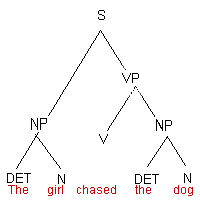
TREE DIAGRAMS 

Take a look at this brief definition of what a tree diagram is and why it is used. Also, pay attention to the examples you have there so they help you do the exercises you have below the image.


Diagram the following sentences:
  1. My teachers at school are strict.
  2. My sister bought a beautiful blouse.
  3. Some intelligent students were a part of the activity.
  4. We appreciate your offer.
  5. The new assistant didn't tell us her age. 

Tuesday, February 3, 2015


CONVERSACIÓN II


Record yourself reading the story and send the audio file:


 Last week, Beth baked a cake for Lilly's birthday party. Lilly wanted a strawberry cake with pink frosting. Beth was happy to bake the cake.

First, Beth mixed the ingredients in a big bowl. Next, she poured the cake batter into four round baking pans. She put the pans in the oven. Finally, she baked the cakes for 20 minutes.

Then, Beth prepared the pink frosting. After the cakes cooled, Beth stacked them and covered them with frosting. Beth wrote Lilly's name on top with white frosting. She put seven candles in the cake.

On Sunday, Beth surprised Lilly with the strawberry cake. Lilly loved her cake! Lilly had many gifts for her birthday. But Lilly said her cake was the best gift of them all!


Friday, January 30, 2015


METODOLOGÍA DE LA ESPECIALIDAD


According to what we covered in class, 


1. Describe the fundaments of the different teaching methods used to work in a ESL classroom.

2. How should an English class be carried out?

3. What are the elements of a class based in the communicative approach?

4. What is the logical way to work the language skills in a classroom?

5. Design a class plan for a class that is supposed to cover the present tense,  practicing daily routines and frequency adverbs. 


Post your answers here or send the info to my email address.


Tuesday, January 27, 2015


Theories of International Relations

Article taken from http://www.sparknotes.com/us-government-and-politics/political-science/international-politics/section2.rhtml

A theory of international relations is a set of ideas that explains how the international system works. Unlike an ideology, a theory of international relations is (at least in principle) backed up with concrete evidence. The two major theories of international relations are realism and liberalism.

Realism

According to realism, states work only to increase their own power relative to that of other states. Realism also claims the following:
  • The world is a harsh and dangerous place. The only certainty in the world is power. A powerful state will always be able to outdo—and outlast—weaker competitors. The most important and reliable form of power is military power.
  • A state’s primary interest is self-preservation. Therefore, the state must seek power and must always protect itself
  • There is no overarching power that can enforce global rules or punish bad behavior.
  • Moral behavior is very risky because it can undermine a state’s ability to protect itself.
  • The international system itself drives states to use military force and to war. Leaders may be moral, but they must not let moral concerns guide foreign policy.
  • International organizations and law have no power or force; they exist only as long as states accept them.
Politicians have practiced realism as long as states have existed. Most scholars and politicians during the Cold War viewed international relations through a realist lens. Neither the United States nor the Soviet Union trusted the other, and each sought allies to protect itself and increase its political and military influence abroad. Realism has also featured prominently in the administration of George W. Bush.

Liberalism

Liberalism emphasizes that the broad ties among states have both made it difficult to define national interest and decreased the usefulness of military power. Liberalism developed in the 1970s as some scholars began arguing that realism was outdated. Increasing globalization, the rapid rise in communications technology, and the increase in international trade meant that states could no longer rely on simple power politics to decide matters. Liberal approaches to international relations are also called theories of complex interdependence.Liberalism claims the following:
  • The world is a harsh and dangerous place, but the consequences of using military power often outweigh the benefits. International cooperation is therefore in the interest of every state.
  • Military power is not the only form of power. Economic and social power matter a great deal too. Exercising economic power has proven more effective than exercising military power.
  • Different states often have different primary interests.
  • International rules and organizations can help foster cooperation, trust, and prosperity.
Example: Relations among the major Western powers fit a model of complex interdependence very well. The United States has significant disagreements with its European and Asian allies over trade and policy, but it is hard to imagine a circumstance in which the United States would use military power against any of these allies. Instead, the United States relies on economic pressure and incentives to achieve its policy aims.
Idealism
Idealism is a specific school of liberalism that stresses the need for states to pursue moral goals and to act ethically in the international arena. Idealists believe that behavior considered immoral on an interpersonal level is also immoral in foreign policy. Therefore, idealists argue that dishonesty, trickery, and violence should be shunned. In the United States, idealism has usually been associated with the Democratic Party since World War I.
Example: As he negotiated the treaty to end World War I in 1918, Woodrow Wilson worked to promote democracy and national self-determination. Wilson’s idealism led him to push hard for the creation of the League of Nations, an international organization that would fight aggression and protect the weak from the strong, in 1919. Scholars use the term Wilsonianto describe a person or group who advocates promoting democracy overseas in the name of idealism.

How Culture Controls Communication

An article taken from http://www.forbes.com/sites/carolkinseygoman/2011/11/28/how-culture-controls-communic
ation/2/


Business leaders know that intercultural savvy is vitally important – not just because they have to deal increasingly with globalization, but also because the work force within their own national borders is growing more and more diverse.

Culture is, basically, a set of shared values that a group of people holds. Such values affect how you think and act and, more importantly, the kind of criteria by which you judge others. Cultural meanings render some behaviors as normal and right and others strange or wrong.
Every culture has rules that its members take for granted. Few of us are aware of our own biases because cultural imprinting is begun at a very early age. And while some of culture’s knowledge, rules, beliefs, values, phobias and anxieties are taught explicitly, most is absorbed subconsciously.

Of course, we are all individuals, and no two people belonging to the same culture are guaranteed to respond in exactly the same way. However, generalizations are valid to the extent that they provide clues on what you willmost likely encounter – and how those differences impact communication. Here are three such generalizations.

Cultures are either high-context or low-context
Every aspect of global communication is influenced by cultural differences. Even the choice of medium used to communicate may have cultural overtones. For example, it has been noted that industrialized nations rely heavily on electronic technology and emphasize written messages over oral or face-to-face communication. Certainly the United States, Canada, the UK and Germany exemplify this trend. But Japan, which has access to the latest technologies, still relies more on face-to-face communications than on the written mode. The determining factor in medium preference may not be the degree of industrialization, but rather whether the country falls into a high-context orlow-context culture.

In some cultures, personal bonds and informal agreements are far more binding than any formal contract. In others, the meticulous wording of legal documents is viewed as paramount. High-context cultures (Mediterranean, Slav, Central European, Latin American, African, Arab, Asian, American-Indian) leave much of the message unspecified – to be understood through context, nonverbal cues, and between-the-lines interpretation of what is actually said. By contrast, low-context cultures (most of the Germanic and English-speaking countries) expect messages to be explicit and specific. The former are looking for meaning and understanding in what is notsaid – in body language, in silences and pauses, and in relationships and empathy. The latter place emphasis on sending and receiving accurate messages directly, and by being precise with spoken or written words.

One communication trap that U.S. business leaders may fall into is a (costly) disregard for the importance of building and maintaining personal relationships when dealing with individuals from high-context cultures.

Cultures are either sequential or synchronic

Some cultures think of time sequentially – as a linear commodity to “spend,” “save,” or “waste.” Other cultures view time synchronically – as a constant flow to be experienced in the moment, and as a force that cannot be contained or controlled.

In sequential cultures (like North American, English, German, Swedish, and Dutch), businesspeople give full attention to one agenda item after another. In many other parts of the world, professionals regularly do several things at the same time. I once cashed a traveler’s check at a Panamanian bank where the teller was counting my money, talking to a customer on the phone, and admiring the baby in the arms of the woman behind me. To her, it was all business as usual.

The American commoditization of time not only serves as the basis for a “time is money” mentality, it can lead to a fixation on timelines that plays right into the hands of savvy negotiators from other cultures. A Chinese executive explained: “All we need to do is find out when you are scheduled to leave the country and we wait until right before your flight to present our offer. By then, you are so anxious to stay on schedule, you’ll give away the whole deal.”

In synchronic cultures (including South America, southern Europe and Asia) the flow of time is viewed as a sort of circle – with the past, present, and future all inter-related. This viewpoint influences how organizations in those cultures approach deadlines, strategic thinking, investments, developing talent from within, and the concept of “long-term” planning.

Whether time is perceived as a commodity or a constant determines the meaning and value of being “on time.”  Think of the misunderstandings that can occur when one culture views arriving late for a meeting as bad planning or a sign of disrespect, while another culture views an insistence on timeliness as childish impatience.

Orientation to the past, present, and future is another aspect of time in which cultures disagree. Americans believe that the individual can influence the future by personal effort, but since there are too many variables in the distant future, we favor a short-term view. This gives us an international reputation of “going for the quick buck” and being interested only in the next quarterly return. Even our relationships seem to be based on a “what have you done for me lately?” pragmatism.

Synchronic cultures have an entirely different  perspective. The past becomes a context in which to understand the present and prepare for the future. Any important relationship is a durable bond that goes back and forward in time, and it is often viewed as grossly disloyal not to favor friends and relatives in business dealings.

Saturday, October 25, 2014


Metodología de la Especialidad

Take a look at this pic and do all four exercises.


Monday, September 29, 2014


Metodología de la especialidad (3rd activity)

Take a look to the following comments on the Communicative approach to language teaching by two middle school teachers and answer the questions below:

"The communicative approach to language teaching stresses the importance of communication and interaction among the pupils and between the teacher and the pupils to learn a foreign language. Rather than repeating mechanically dialogues or grammar rules learnt by heart, the communicative approach encourages pupils to use the target language in semi-authentic contexts. This approach also values the pupils' personal experiences outside the classroom as a way to facilitate their learning in the lesson. So most of the tasks of this approach demand that pupils work in pairs or in groups and discuss different aspects of their lives (free-time activities, likes/dislikes, have you ever done this or that). Another common task in the communicative approach is games like guessing as students have to ask and answer questions among themselves to do them (Choose a character from Spiderman. Your class mates have to guess who you are. Use Are you ....? and the short answers Yes, I am No, I'm not). Grammar points are introduced to support the learning of the structure in question (in the previous example, the inversion between subject and be in yes/no questions)
The good thing about the communicative approach is that it makes students speak the language even at a beginner level and they are usually enthusiastic about this. One negative aspect that I can see is that the study of grammar is somewhat pushed to the side and pupils find it increasingly difficult to be aware of how a language works".
"Students learn languages best by using them.  If you have students constantly practicing their language skills by talking to each other, they will gain confidence and learn more quickly. The key is to create a safe environment, where it is ok to make mistakes.  Kids will be embarrassed that they might say something wrong.  I remind them that everyone in the room is a learner except me, and I am not going to laugh at them or ridicule them for making a mistake!  Have them talk, talk, talk!"
  1. Would you rather practicing structures and vocabulary with drills or discussing situations from our context? Explain. 
  2. Do you prefer working alone or in pairs when it comes to reading and writing activities? Why?
  3. Are you fond of games in class to practice different structures and/or vocabulary? Explain.

Wednesday, September 24, 2014


2nd activity
Metodología de la Especialidad


1) Watch the video and write a summary of how the class is carried out.


2) In a 20 sentence summary, explain how Suggestopedia works and how it's perceived by different people.